
Next month I’ll be sharing my first instalment of mythological research sources for your fiction writing – it’s nearly ready and something I’m way too enthusiastic about – but this month I’ve been thinking about marketing (again, and mostly “Why is marketing so hard?”) and I wanted to share some of my experiments with you.
On a recent call with an editorial buddy, we decided that generative AI is a bit like cutlery – how you use it is up to you. It can be helpful … but you could kill someone with a spoon. AI use is often polarizing in the writing community. But it’s not all or nothing when it comes to using generative AI in your business, including if you’re a self-publishing author. There is more to it than “Should I get AI to write my novel?” No, probably not! But you could use it to help with marketing and productivity.
Have you noticed how artists and designers seem to get the best AI-generated art? While I believe the most incredible art and novels will be human generated, what if the rest of us could use a small percentage of AI input to increase efficiency and help with some of the aspects of our work we might otherwise be struggling with? AI can support and complement us rather than replace our creativity and expertise.
Let’s explore some ways you could use generative AI for support without feeling like you’re cheating at writing, because you’ve already done the writing bit.
- Repurpose your content
- Prepare for promotional events
- Bypass writer’s block
- Tricky book-related bits
- Code macros
- Conclusion
Repurpose your content
If you’ve ever published a blog post and left it sitting on your website never to be mentioned again, this is for you. We all know we should make the best use of things we’ve already written, but maybe we don’t know where to start or don’t prioritize it.
Let’s be honest, maintaining a social media presence can be exhausting and could easily eat into our creative writing or editing time if we let it. I’m a serious hermit and like to conserve my social energy for the most important things. Sometimes I disappear for too long. Even though I’ve made some cherished relationships that began on social media, public online spaces can feel a bit much. What if AI could help you maintain a presence without feeling overwhelmed?
Try this to get a description of your writing style and tone:
Please summarize the writing style and tone in this text. I want you to remember the writing style and tone of this text as “My Style”. Here is the text: [paste text from your About page or a blog post].
Try this to compare your post with your writing style:
Here’s a recent social media post of mine. Does it fit with “My Style” or could it be improved? Here is the post: [Paste in social media post].
🤖 [review response]
Can you suggest one way I could improve my future posts?
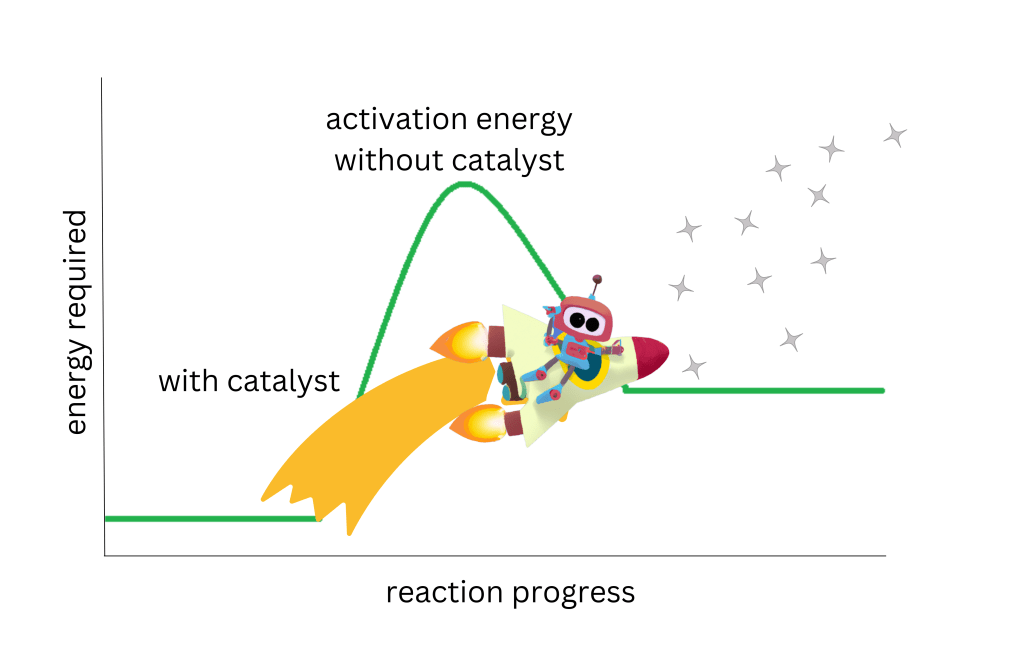
I’m experimenting with AI to help me batch-create social media content from my own blog posts. I still rewrite, scrap, or change so much that it’s my writing, but it gets me over the initial hump of resistance that starting this job has presented me with! (I’m trying to build up a bank of posts for busy seasons, and I haven’t posted any yet.) AI reduces the activation energy required for me to get started on this particular task. That’s how I think of it anyway!
Avoiding the hump of resistance:
This next prompt was inspired by a friend (thanks, Frank). Frank Prendergast talks about the repurposing prompt I based mine on in this podcast episode, complete with skimmable transcript.
Try this to extract relevant points from your blog posts:
Let’s repurpose one of my blog posts. Choose the 3 most practical and unique stand-alone points, number them Point 1, Point 2 and Point 3. Here is the post: [paste text]
🤖 [review response and make suggestions]
Great! Suggest three ideas for social media posts for [chosen platform] all about Point 1. Use the same style and tone as the original content, infused with “My Style”.
🤖 [review response and request specific improvements]
Prepare for promotional events
Generative AI has been one of my prongs of attack for building confidence with interviews about co-authoring The Most Amazing Marketing Book Ever. “What if they ask me difficult questions?” Taking action is a better approach than worrying, and I’ve used AI to suggest counterarguments or criticisms of my work with surprising results. It was actually really good at this! And I felt a whole lot more prepared and competent as a result, like it helped me to see what I already knew. What’s something you’re scared of? Maybe generative AI can help you explore your thinking. I felt way more prepared and confident enough to do a live interview!
Try this to get contrasting opinions:
Ask 5 awkward and challenging questions about my work on [topic] that I might find difficult or uncomfortable to answer. Here is my work: [Paste in work]
Bypass writer’s block
While I don’t necessarily believe in writer’s block, it’s natural to sometimes feel stuck with your writing. We’ve all sat there staring at a blank page before. You might just need a walk, a snack, or a rest. But you might like to use AI as a catalyst to help you get your ideas flowing again. Even if you hate all of its suggestions, it can help you come up with your own.
Try this for fun writing prompts:
Write 5 writing prompts for me to practise fiction writing today. I want to practise different narrative points of view.
Try this for brainstorming scene ideas:
Here is a paragraph of my writing. Suggest 5 scene ideas about what could happen next. Here is my paragraph: [paste text]
Tricky book-related bits
You’ve written your book, and it’s edited and ready to share. Nearly. Now comes more hard stuff. It can be tricky to condense the main elements of your novel into a compelling synopsis that’s in line with the heart of your story. And a catchy one-liner for an elevator pitch – where do you even start? But these are valuable activities if we hope to indicate to the right people why they should care about our story.
Try this to get ideas for a synopsis and elevator pitch:
What makes a good synopsis for a novel?
🤖 [review answer and add your own suggestions]
Here’s a description of my story. What are the main things I should emphasize in my synopsis? Here’s my story description: [paste text]
🤖 [review answer and add your own suggestions]
Can you suggest a one-sentence elevator pitch for my story?
You might find the odd useful nugget if you generate a few alternative versions.
Code macros
If you’re writing or editing, chances are time is a factor. The more we can streamline arduous tasks the better because then we can focus on more creative challenges that require human judgment. For example, is that full stop italic or not? AI can pick that up for you. Does that full stop need to be italic? You’ll need to decide or query it with your client.
You don’t need to spend hours searching for a macro and re-learning how to install it (there are many with instructions generously shared online). AI can code you a macro to test and give you step-by-step instructions on how to use it. With AI-coded macros, we can craft personalized tools to suit our specific writing and editing needs. What editing task do you do repeatedly in your current manuscript?
Try this for a macro that makes italics easy to spot:
I am an editor. Can you help me write macros for Word?
🤖 [it provided me with helpful “getting started” instructions like enabling the Developer tab, in case you haven’t already]
Can you write a macro that will give italic text a coloured background?
🤖 [it gave the macro code and helpful step-by-step instructions]
Oh my gosh that is amazing, the macro worked beautifully, thank you!
(Yes, I really talk to ChatGPT like this because that’s how I want it to talk to me 😅)
Conclusion
From repurposing content, preparing for promotional events, bypassing writer’s block, to tackling tricky book-related bits and coding macros for productivity, AI has proven to be an invaluable assistant in my experiments. It has saved me time and helped me gain new perspectives, but the main benefit for me is that I can use it as a catalyst: it reduces the activation energy I need to get started on certain tasks, and often getting started is the hardest part.
Generative AI, like cutlery, can be wielded with care and purpose in our writing and editorial work. It’s not about replacing our creativity but using it as a tool to support our endeavours. Human judgment, expertise, and creativity are still essential.
We can explore and experiment while staying true to our voices and stories. Do you use generative AI? I’d love to hear your success stories or thoughts.
Did I use AI to write this post?
Not for writing, but I kind of consulted it while writing to keep myself on task. I drafted in Word as usual, put my main sections as bullet points to get my idea for overall structure down. Started fleshing out some of my ideas, we’re talking very messy first draft. Changed the title a bit. Chatted to ChatGPT and asked it to “help me think this through,” sounds a bit sad I know, but I work on my own a lot! There were suggestions I flat out ignored, and some that helped me think.
I wrote and edited myself. Because this post is about AI, I tried something new: asking for headline suggestions. I didn’t like any of them, but but then I had an idea to improve my own. I’ve been continuing to experiment with ChatGPT 3.5 because it’s free and accessible where I live. You might have access to different tools and get different results.
 Joanne Taylor • Ajatar Editing
Leave a comment